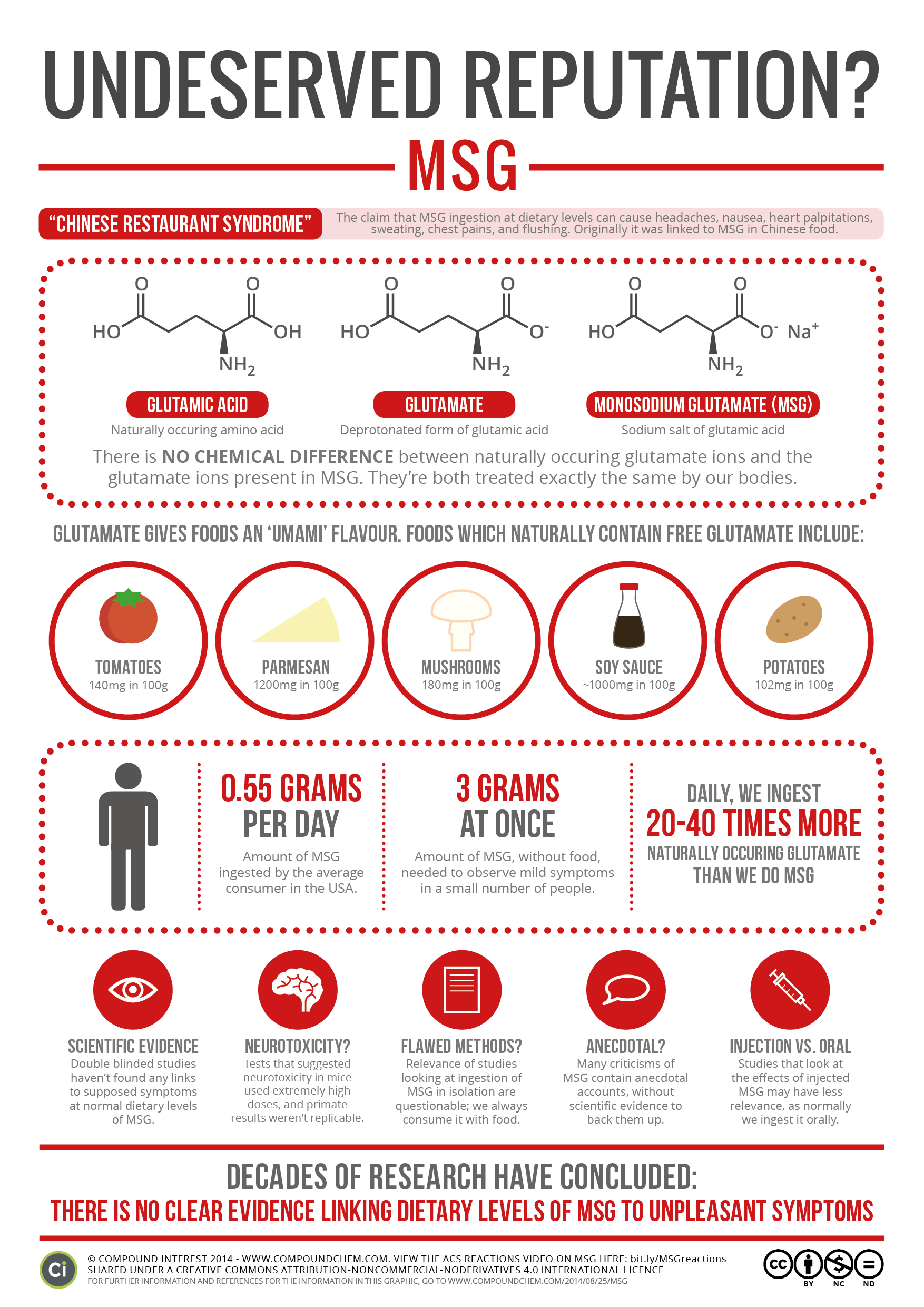
Monosodium glutamate, or MSG for short, has long been the villain of the food supplement world. In the UK, Chinese takeaways proudly display ‘No MSG’ signs beside their counters, and many websites will purport to tell you ‘the truth about MSG’. Numerous studies have been carried out examining the effects of MSG, but with all the conflicting information, it can be hard for consumers to know who to believe.
MSG was first isolated from seaweed in Japan in 1908. It was said to contribute an ‘umami’ flavour when added to dishes; ‘umami’ is derived from the Japanese word for ‘tasty’. By the mid-20th century, MSG was a commonly used supplement in Japanese and Chinese cuisine, and had also spread to numerous other countries, including the USA, where it was routinely used in restaurants and takeaways across the country.
The term ‘Chinese restaurant syndrome’ was coined by a Chinese-American doctor, Robert Ho Man Kwok, who wrote a letter to a scientific journal complaining of experiencing palpitations and numbness after eating in Chinese restaurants. Kwok didn’t identify any particular component of his meal as causing this effect, but, despite the scarcity of evidence, MSG was quickly fingered as the culprit. A study carried out by a Dr John Olney around the same time found that, when MSG was injected into the brains of mice, it could cause brain damage.
Whilst this may seem concerning, an oft-omitted fact when reporting this study is that Olney used huge quantities of MSG in his studies, up to 4 grams per kilogram of body weight all at once, an amount many times higher than humans are likely to consume as part of a balanced diet. To put this into perspective, in industrialised nations it’s estimated we ingest no more than 1 gram over the course of a day, and often much less. In order to match the highest dosage used in Olney’s tests, we’d have to consume 300g of MSG all at once – a quantity many times more than the amount of MSG found in an average Chinese takeaway meal.
Olney also produced results in primates with high doses of MSG, but these haven’t been replicated by other studies attempting to observe the same results. Whilst this doesn’t completely discount Olney’s observations, replicability is a very important part of scientific testing. Without this, we don’t have convincing proof that high amounts of MSG can cause brain damage in primates, nor can we really state anything about human reactions to MSG from these results.
Another study of interest is one carried out in the 1970s, which for six weeks fed 11 subjects up to almost 150 grams of MSG, and noted no ill effects as a consequence. The fact of the matter is, that despite the plethora of symptoms that MSG has been linked to over the years, there is absolutely no scientific evidence for any of them. Numerous studies and reviews have failed to find any correlation between undesirable symptoms and MSG, and its use as a food supplement is still approved by food regulatory bodies. The few trials that have found links have often been criticised for poor trial design – for example, not having any blinding of testing, so subjects knew that they were ingesting MSG, which could obviously colour their feedback.
Chemically, MSG is simply the sodium salt of glutamic acid, which is a naturally occurring amino acid. Glutamate, the deprotonated form of glutamic acid, is found in tomatoes, ham and cheese, and is chemically the same as MSG – both are treated in exactly the same way by the body. If MSG did cause the symptoms commonly attributed to it, then you’d fully expect eating foods high in glutamate to produce exactly the same effect. Oddly, you don’t tend to hear anyone complaining of ‘Chinese restaurant syndrome’ after eating cheese.
Some people may point to anecdotal evidence of their own, that they’ve experienced allergic reactions to MSG in foods. Well-controlled studies have failed to find a link, however; in one study, in which 71 subjects were administered either MSG or a placebo, only one subject reported a reaction. This subject received the placebo in the test. Many other tests have documented cases where subjects who identify as MSG sensitive react to the placebo test, rather than MSG, suggesting there may also by psychological factors at work. It is suggested that a very small number of people may be sensitive to larger amounts of MSG, but the symptoms of this reaction are mild. Those who complain of MSG sensitivity may also be reacting to some other substance in the food, rather than MSG itself.
Regardless of the scientific evidence, the calls from some quarters to ban MSG from all foods are a little over the top. The possibility of mild reaction in a very small number of people, and only when amounts much higher than those usually present in our diet are ingested, shouldn’t be a cause to ban it as a food additive for the vast majority of consumers for whom it is documented as having no effect. In summary, it’s clear that MSG is somewhat the victim of a character assassination, and we shouldn’t be worrying about the amounts we ingest on a daily basis. However, if you want to read more of the evidence yourself, check out the links supplied in the references section below.
References & Further Reading
Review on MSG – Food Information Council Foundation
Brain damage in mice following intake of glutamate – J Olney
MSG: a double blind study and review – L Tarasoff & others
A short history of MSG – J Sand
MSG ‘allergy’: menace or myth? – A N Williams & others